


Mimicking The Style of Jeff Lynne
- Stacey Wood
- May 24, 2019
- 4 min read
I admire Jeff Lynne's work with Electric Light Orchestra and many others, and I would like to mimic his producing style to learn from his ways as well as seeing what is behind some of very popular songs. To start I must research Jeff Lynne, and how he worked in the studio, what did he do that made his work stand out. I have devised a bullet point list of my findings:
. Mics up his snares, top and bottom
. Uses a gated white noise on snare
. Only uses one overhead microphone
. Likes to capture the room sound for drums
. Mixes the bass low on the mix
. Uses high pass filter on guitars
. Pans his guitars
. Likes to mic snare from further away and compress it so it sounds closer
. Dynamic squashing on bass
. Heavy drum compression
Now knowing all of these things about what Jeff Lynne did in the studio and when mixing, I took it upon myself to mix and record songs in the style of Jeff Lynne. I recorded a funk song, and am mixing a Dumb Poets song. To take you through the process of how I got to my Jeff lynne mimicked songs, I shall detail below.
Here is an overview of what my final mix looks like:
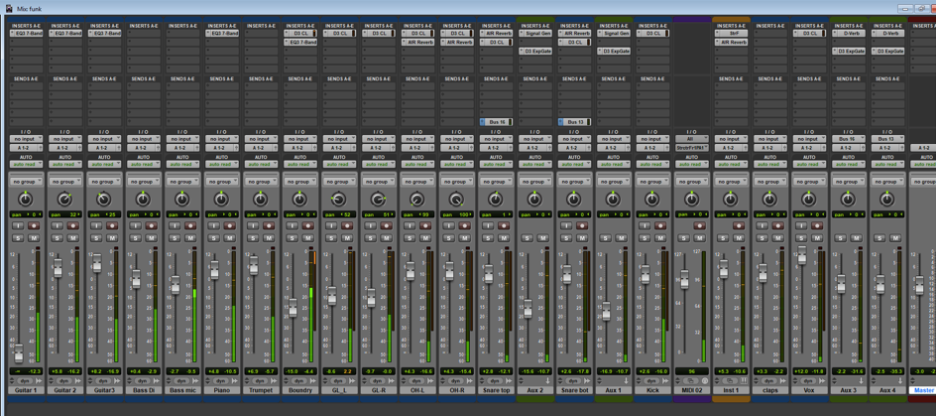
To get to this point I took the drums as my first interest. Jeff Lynne has such a specific drum sound, he likes to capture the room sound of the drums, and he likes to make his snare really prominent. To get to this point i started at recording; I used two clip on AKG C518 M microphones on the top and the bottom of the snare, along with this I used a boundary effect placed in the corner of the drum room to really capture the room sound Jeff Lynne seems to love.
Most of Jeff Lynne's style is deveoped in mixing, so I move to mixing next. With the overhead microphone I used a heavier compression:

To do this I made the knee hard, the ratio slightly high, and the threshold set lower. However, the most important thing about Jeff Lynne compression is that he likes to have a very fast attack time, and a slower release time for his compression, so you can see I tried to mimic that.
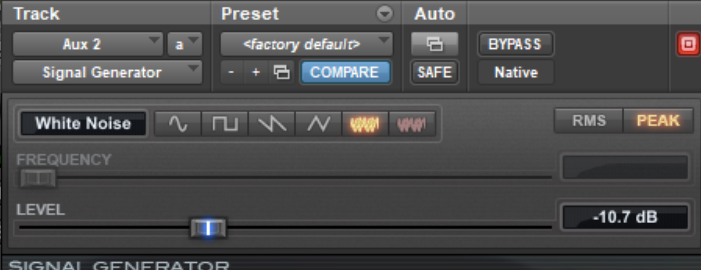
Continuing from my research, I found out that Jeff Lynne is known to gate white noise onto the snare drum to give it an extra burst. I did this by sending the snare to a bussed gate:
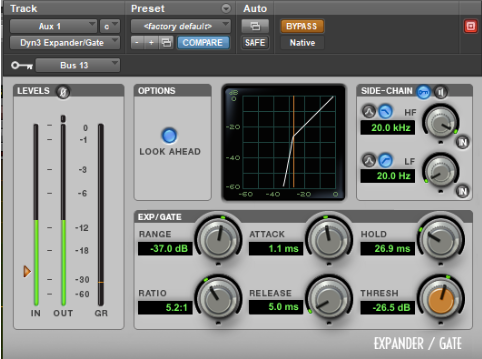
As you can see from the screenshots provided, I created a gate that let through every snare hit, and then used this gate to apply white noise via the signal generator. This was done in a separate aux track. This technique proved to be extremely successful, and instantly gave me the feeling that this made the drums feel like a Jeff Lynne mix.
Once I did that, I focussed on the kick drum a little more, as the kick drum was not recorded very well and so was very quiet in my mix. Jeff Lynne always liked the drums being a big asset of his mix, so I needed to fix this. What I did was, I re recorded a kick in the studio, just hitting a single kick on its own. I then took the kick recording from the original recording used cubase to covert a midi data file from this audio file, I then placed that midi file into ProTools again and used Structure Free to map my new kick drum to the MIDI data of the original kick. Here is a screenshot of the structure free plug in:

The new drum sample was working very well, however, I still wasn't receiving that Jeff Lynne room sound from my overhead, so I chose to add some reverb to add some room sound myself. If I did this again I would've brought the drums out of the drum room into the centre room to capture more natural reverb. However, I am working with what I have.

As you can see I added a small amount of reverb to the mix by adjusting the room size and reverb time, and bringing down the mix so it was not too overpowering. This really improved my room sound along with the boundary microphone.
The final part of the mix is the guitars. Jeff lynne loved a bright sounding guitar, he used a lot of EQ on his stringed instruments, therefore, I applied a strong high pass filter to all my guitars. I did this by grouping all the guitars into one aux track, and applying an EQ to this aux track, this avoids phase shift within EQ. Here is a screenshot of my EQ on the guitars:

Adding the EQ to the guitars was a huge step towards the Jeff Lynne end goal. I was very pleased with how my mixes turned out, the drums were heavily compressed, with a lot of room sound, and a very snappy snare, along with bright sounding guitars. It really shaped up to become a Jeff Lynne styled mix.
For the vocals, I left them clean, as Jeff Lynne in his later career preferred his vocals remain untouched for the raw natural feel to the sound, he may use some reverberation here and there, but not many at all.
If I were to do this again, I would experiment more with different locations to get more natural reverb, as this is key to Jeff Lynne production, as well as this, I would've liked to have taken more takes of the Funk recording so the bass drum could have been perfect from the offset.
Comments